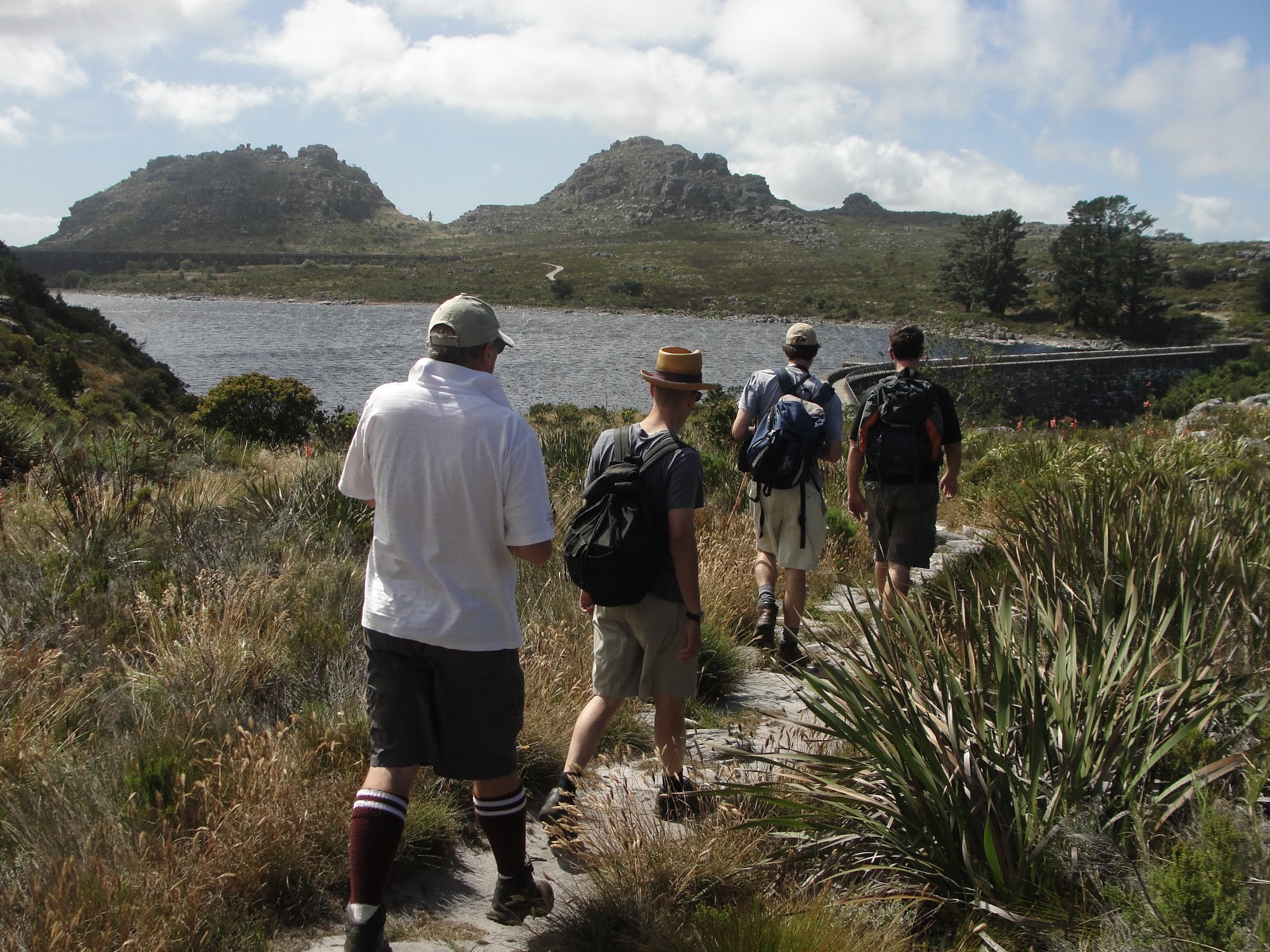
Saturday, 4 September 2010

Table Mountain - Some Easy Ways to the Summit (1913)

This is a guide book published in 1913, which I scanned, OCRed and converted to PDF... enjoy! It's an interesting read, not least to see how our use of English has changed, but also to see how the mountain has changed in some ways and stayed the same in others. Back then, there was no Tafelberg Road, so the Platteklip Gorge ascent started on Buitenkant Street. For the pipe track, you could take a tram from the city to Kloof Nek. For the Saddle, the path started at Forester's Arms. You know, all those times I've been to Forries, despite the name, it never once occurred to me that it used to be the gateway to Newlands Forest and the mountain. That was before De Waal Drive was built, of course.

Most of the routes described are still popular, but please don't head off onto the mountain following this guidebook as if it was still current. Over the past century, paths have come and gone, some ravines (Slangolie) have become largely impassable due to landslides, rights of access have changed (Orange Kloof), and our tolerance for risk (Blinkwater / Stinkwater) has also changed...

Table Mountain - Some Easy Ways to the Summit (1913)

Tuesday, 10 August 2010

Mowbray Ridge and Minor Peak

Mowbray Ridge is one of my favourite hikes on Devils Peak, not least because I grew up in the shadow of Devil's Peak, and as a student it was one of the closest hikes from UCT. Most recently I've enjoyed it because you can fit a lot of scenery and serious ascent into an energetic half day, and still be back home to spend some quality time with the wife and kids. The last time I climbed Mowbray Ridge was a date I will not forget for two reasons, one of which, tragically, I blogged about at the time. But now it's time for an article about the hike that preceded that.

Mowbray Ridge is the northeastern corner of Devils Peak, and a very windswept corner it is too, especially when the Cape Doctor blows, which is most of the time on the ridge. The vegetation and outlook changes dramatically along a sharp line: lush and bushy on the eastern slope overlooking the Southern Suburbs and Cape Flats, and dry, frequently burnt and grassy overlooking the city and harbour on the north.


At the base of the ridge is Plumpudding Hill, a rounded grassy shale outcrop above Rhodes Memorial. For years there was a radar beacon there, a sort of technological memorial to three fighter jets that crashed into Devils Peak in low cloud in 1971. The radar beacon has gone but the trig beacon and view are still there.

Further up, at the base of the cliffs, is the King's Blockhouse, another beacon and a couple of cannons. It's the best preserved of the forts on Table Mountain, and is still used as a radio relay station, I think. The area between Rhodes Memorial and the Blockhouse is unfortunately a hotspot for mountain muggings, so be warned.

Behind the blockhouse the climb starts in earnest. It climbs and scrambles rapidly through various cracks in the purple sandstone to the right of the ridge, and soon reaches a magnificent viewpoint at an old fire lookout house, now abandoned. One of the great 270-degree views on Table Mountain.

The path continues up the ridge and climbs less steeply on an open slope. At one point you have the choice of going along the Upper Traverse contour path to the right, or heading straight up the ridge. The path to the right is better in heavy wind if you have a fear of heights: straight ahead, the knife edge ahead is not for the faint-hearted, as it overlooks a huge drop into the enormous First Waterfall Ravine on the left.


The knife edge descends slightly, then climbs again, ending in a short and steep scramble to Minor Peak, just above the nek at the top of First Waterfall Ravine. Really, with the sense of achievement you get at that point, it should have a more commanding name.

From Minor Peak, you have several options:
  • Descend to Upper Traverse, and continue down to Middle Traverse, then turn left and work your way back down on a series of descents back to the blockhouse.
  • Or descend to Upper Traverse, turn left, and continue onto the Saddle from which you can slog up the final slopes of Devil's Peak (and then down Newlands Ravine, perhaps).
  • Or, if you know the way (be warned: it is easy to get lost in very dangerous terrain on this route), take the frontal ascent to the top of Devil's Peak. Again, definitely not for anyone with a fear of heights.

Monday, 7 June 2010

Wit Els 2001

While I'm on the subject of photos for Bruce... here are some photos a kloofing trip we did down the Wit Els, back in 2001. I can't quite believe it's been so long since I last went been down this magnificent river, but I'll be back one day.


Bottom hut


Middle hut


Pell's Hut, newly renovated


On the long descent from Waaihoek into the gorge.


Disa Falls, and Bruce trying unsuccessfully to get a GPS signal.


One of the swims, or perhaps one of the wades


Waterproofing the packs


Definitely one of the swims


And another


And another.


Me, at Alder Ring campsite


Dave


The gang, or most of them.

Wednesday, 2 June 2010

Tafelberg, 10 years ago

Some photos from a winter hike up Tafelberg, 10 years ago, by popular request from Bruce...


The gang, The Spout, and my favourite peak.

Snow near The Spout, and me, Dave, Lynette, Bruce, Bruce, Bruce and Bruce. Photoshopping was harder in the days before digital.

Me, tied-dyed shirt, and Sneeberg across the valley.

Bruce looking down from the Spout. Remnants of snow around Consolation Peak.

Broken MSRs at Spout Cave

Ice at the overnight spot.

Dave

Lynette

Sunset from The Spout.

Friday, 23 April 2010

Plumpudding Hill

My cousin Mandy died suddenly on 18 April 2010.

I wonder where you were, the day you heard
that Mandy died.
No, it cannot be, not Mandy, no, we cried.
Some moments, like the death of Princess Di,
Ingrain themselves into the mind
But close to home, do more:
Break time in two, define
Before, and Now.

May I share where I was, the day I heard?
A mountainside, not far from home.
Plumpudding Hill on Devils Peak, the view sublime.
I took the call (the wretched phone
rang deep inside my bag). It was my wife
My own dear wife
To break the awful news.

No, not Mandy, no, not now
So young, too soon, so full of love and life,
My cousin, no
Her children – husband – mother – father – brothers – us
How can they – how can we all – go on?

But on we go.
I stumbled home, to go to the bedside
To say goodbye,
Too late of course,
To see for one last time
Her face, her hair, golden on the pillow.

Now, every day, I see that mountainside,
A backdrop to my life,
Identify the windswept spot
Plumpudding Hill on Devils Peak
Remember Mandy and recall
Her smile, her laugh, her love, her life
The breeze, the smell, the view
Not just the day, the place, the time, and how I cried

Wednesday, 17 March 2010

Smuts Track: Skeleton Gorge to Maclears Beacon, and down Nursery Ravine

Smuts Track is one of the most popular hiking routes on Table Mountain. It's named after Jan Smuts, who was a keen outdoorsman and hiked this route energetically and regularly, well into his old age. Here's why I like the route.

Firstly, Skeleton Gorge. This is one of the most popular and most pleasant routes up Table Mountain. It leaves from Kirstenbosch, climbs through beautiful and shady indigenous forest, takes in a waterfall, includes a few wooden ladders and a scramble up a rocky stream bed, past a cave which is a perfect resting place, and finally emerges from the forest to give you a superb view over False Bay and the Southern Suburbs. It's not the easiest route, though: it's rocky and can be slippery near the top, and should be avoided in winter or after heavy rains, and like any direct ascent it can be challenging if you're not that fit.

Once you're at the top of Skeleton Gorge, follow Smuts as he takes a sharp right and starts a more gradual ascent from the Back Table towards Table Mountain itself. This is a superb route in its own right, with clifftop views, dramatic drops (and a detour to Carrell's Ledge if you're up to it), a ruined cottage if you have the Slingsby map, disas and watsonias in bloom at the right time of year, and bizarre rock formations.

Then the top. Maclears Beacon is the highest point on Table Mountain (1086m) and has fantastic 360 degree views over the entire peninsula on a clear day. The wind can whistle and the tablecloth can cover you at any moment though, so be prepared for a bit of chill, even in summer.

From the top, it's a flat but fairly lengthy walk to the Cable Station, or you can descend via Platteklip Gorge, which is a long zigzag staircase taking you down towards the City Bowl. A good, efficient descent if your knees are up to it, and a very popular ascent too, even if it is rather unrelenting and exposed in summer.

I prefer a longer return journey, which takes you back to Kirstenbosch. From Maclears Beacon, retrace your steps until you are about half way back to Skeleton Gorge. Then turn right and follow an old stone aqueduct, which takes you through a pleasant and secluded valley ending at Hely-Hutchison reservoir. Unexpectedly, at the century-old dam wall, there is a waterworks museum which is worth a visit.

Then the descent via Nursery Ravine. It's similar to Skeleton, with great views and pleasant indigenous forest, but it's steeper and less shady than Skeleton Gorge so I don't generally choose it as an ascent. As a descent, it is great, because it has fewer irregular rocky parts and is less slippery than Skeleton, especially in winter. It also gets you down quicker.

Monday, 1 March 2010

Karrimor Jaguar 2 - gone to a new home

Saturday was a sad day. The top section of my wardrobe was getting out of hand and threatening to tumble out all over me, and it was time to donate my old backpack to a worthy cause.

Now this was a special bag. A Karrimor Jaguar 2, 65 litres, which I bought in December 1985 when I was a 12 year old Scout and just starting to do some real hiking. It cost R127.95 less 15% discount, plus 13% GST (I kept the receipt), money I got from Christmas presents and from a smallish cash prize I won at school. It came from a tiny but outstanding outdoor store called Camp and Climb in the basement of Cavendish Square, sadly long since closed.

Good design? Yes sir. Back then it was a new-generation internal frame bag that was comfortable as heck and seriously impressed the adults and older boys who I hiked with. It came in KS100E material with a lifetime guarantee, in an elegant shade of pale green. You could yank the straps while you wore it, which they called SAS, or the Self Adjusting System. I admit the last 24 years have seen some useful innovations in pack design (although I exclude those ridiculous bladder-water-pipe arrangements from that category), but nothing as revolutionary as the shift from external frames to comfortable, carry-able, packable-and-unpackable, adjustable, internal frame packs like this one. My 24 year old Jaguar 2 was still a match for most of today's packs.

Durable? Oh yes! 24 years later and the only damage was a small worn-through slit in a side pocket, where I once packed two gaz cylinders with metal rims which wore through the material when brushing against passing rocks. I learnt a small lesson about packing from that. The unbreakable hip belt buckle outlasted several buckles on my newer Backpacker bag. And I never did get to try out the lifetime guarantee, although later bags came in a material called Silvaguard with a 10 year guarantee which didn't last nearly as well. (Karrimor, to their credit, honoured that guarantee, but Silvaguard was never a match for KS100E).

Clean? Well, no longer. In 1989 a fellow Rayner Trophy teammate kindly packed a bottle full of cooking oil in my bag without telling me, and it popped open. 750 ml of sunflower oil left some interesting tie-dye patterns on my sleeping bag, and some stains on the bag, but actually seemed to increase the waterproofing. Yes, it was washable, in a big bath of warm water and a few days in the sun to dry out the capacious foam hipbelt, but the cooking oil pattern lived on.

Well used? Absolutely. From my early teens, through my Springbok Scout hike, down the Wit Els three times at least (soaking up most of the river in the foam padding along the way), four 10-day Cederberg Adventures, all over the Cape, in all weather. I used it exclusively for more than 10 years, then decided I needed a larger 75 litre bag, but the Jaguar 2 kept going, either to lend out (it probably did more Cederberg Adventures in that role than I did) or for hikes where a smaller or older bag was more appropriate. The last major outing I can remember taking it on was the Wit Els in 2001.

Why pass it on now? You know, I'm not sure. I could have kept it in reserve and lent it out a few more times, and maybe I'll do the Wit Els again one day. But to be fair, its time had passed, and even the bag I bought as its successor is now a 14-year-old well-worn, well-travelled pack, with more hiking (and more airline miles) behind it than most packs can dream of. I could have kept it another 10 years until the kids are big enough to use it, but to be honest, it would probably not inspire the same reverence in them that I felt it deserved.

I drove around with it in the boot of my car (an Opel Meriva - similarly functional but sadly less durable) for a while, putting off the moment, but eventually I just had to grit my teeth and hand it over as a donation, along with a few other lesser items to reduce the blow.

Miss it already? You bet. Oasis in Claremont - you don't realise that you just got one of your finest gifts yet.